The main revenue models for an app (and how they fit the Iranian market)
Choosing the right revenue model for an app
The technical and design challenges of building revenue models
Successful examples in Iran
The part intelligent design plays in increasing revenue
One of the common mistakes in designing an app is deciding on the revenue model at the end of the work, when how an app will earn should be part of its design from the very start — not something added on after it is built. That decision affects everything: the structure of the interface, the payment experience, the rate at which users stay, and even whether the product succeeds or fails. In Iran, constraints such as sanctions, particular payment models and users' habits make the route to earning from an app somewhat different. What works in another country with a dollar subscription or international advertising may come to nothing in the domestic market. In this article, rather than repeating theoretical models, we look at the methods that can genuinely be used in Iran: in-app advertising, in-app purchases, subscriptions, selling services, and the creative combinations successful apps have used. Our focus is on practical, workable analysis — not a theoretical list.
The main revenue models for an app (and how they fit the Iranian market)
On the face of it, there is not a great variety of revenue models for an app. In practice, though, choosing between them depends on the kind of app, on users' behaviour, on payment infrastructure and even on the platforms' own constraints. In the Iranian market, some models have worked better, others need adapting locally, and some are unusable altogether. Below we look at the most important models with a realistic eye:
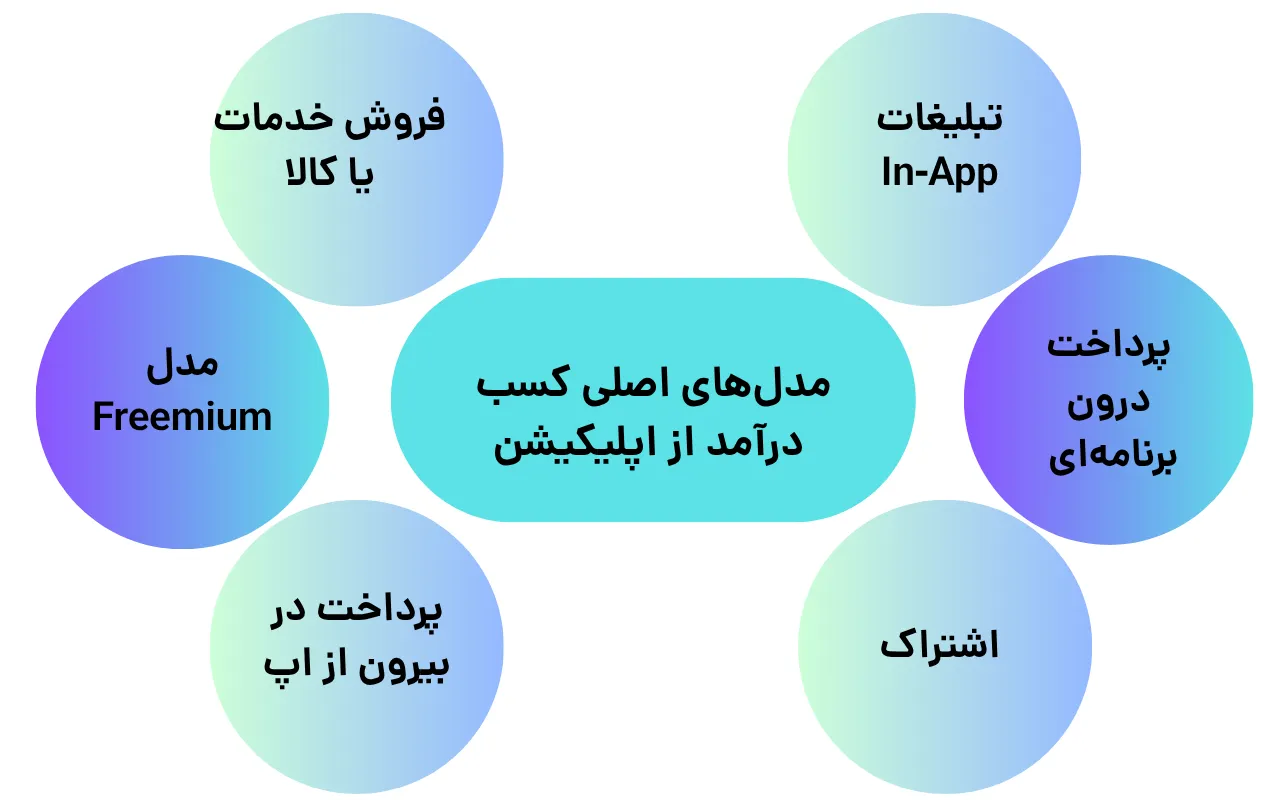
In-app advertising:
A simple and tempting model, but not always effective. Video, banner or interstitial advertising can be a good source of revenue, particularly for apps with high traffic and a general audience. In apps that call for focus or continuous engagement, though, a lot of advertising can be irritating and work against the user experience.
In Iran, working with domestic advertising networks (Tapsell, Adad or MediaAd, for instance) is common; but real revenue only comes where the number of active users is large.In-app purchase (IAP):
Buying a tool or a feature from within the app — unlocking a course, buying gems in a game, or reaching a particular file. In stores such as Cafe Bazaar or Charkhoone, this model is built on a direct payment gateway, but challenges such as high commission, limits on what can be sold and dependence on the store's approval have to be weighed.Subscription:
A monthly or annual subscription suits apps offering a continuing service — music streaming, reading, fitness or education, for instance. The advantage of the model is recurring revenue; but in Iran many users are still not used to paying periodically, and winning a loyal subscriber takes genuine value and content that keeps coming.Selling services or goods:
Apps that themselves provide a service or a product — from ride-hailing to an online shop or home services — usually have a direct revenue model. Here, designing the ordering, payment and support process matters more than the model itself.The freemium model:
Combining a free version with paid features is one of the most widely used models in educational, productivity and personal finance apps. In it, the user is first attracted free of charge and then, if satisfied, buys the additional features. Designed properly, it produces a good rate of both acquisition and conversion.Out-app payment:
To get around stores' constraints or their high commissions, some apps put the payment link on a website or in a messaging app. This is common particularly in apps that cannot be published in the official stores, or that for technical reasons cannot use the domestic gateways. It carries the risk, though, of the user leaving the app and of a lower conversion rate.
Choosing the right revenue model for an app
Which revenue model suits an app depends on a number of factors — and the wrong decision here can disrupt an app's whole path to growth.
The kind of audience (B2C or B2B):
If the app is designed for a general audience, models such as advertising, IAP or subscription may be effective. In B2B apps, direct payment or a corporate subscription is usually the better option.The kind of service or content the app provides:
An app offering educational content can use a freemium or a subscription model. Apps offering practical services usually focus on direct payment or on selling the service. Entertainment and games are the best setting for advertising and IAP.Combining models:
In many cases, using one model alone is limiting. Combining advertising with a subscription (showing advertisements to free users and removing them for subscribers, for instance), or offering the basic features free alongside the purchase of particular capabilities, can produce more balanced revenue.
The technical and design challenges of building revenue models
Designing an app is not merely building beautiful screens. Once revenue is involved, designing the payment experience and the financial interaction with the user becomes vital.
Easy, trustworthy payment:
Every second of delay, every unclear message, every complicated process can put a user off buying. The design of the payment screen, the order of the steps and the clarity of the prices should be free of obstacles and should build trust.
Showing advertisements without damaging the UX:
Advertising shown in the wrong place, in too great a volume or at the wrong moment has the opposite effect. Designing advertising slots so that they do not get in the way of what the app does is an important skill in product design.Managing subscriptions, cancellations and renewals:
Buying a subscription should not be only a purchase; the user experience should also make room for seeing, renewing, cancelling and receiving notice about it — without having to visit complicated or external pages.
Analysing user behaviour:
Internal statistics and analytics tools can help us understand where users buy, where they give up, and which plan is chosen most often. That data should feed directly into refining the design.
Successful examples in Iran
Many revenue models are described in international sources, but successful domestic examples are a better guide for analysing what works in Iran. Looking at them can give us a realistic view of how feasible each revenue model is.

Rubika: this super-app uses a combined model: part of the service free, part by subscription (film and series streaming), and part supported by advertising. What is notable in Rubika's design is the simple, clear UI on its subscription and payment screens. The colours, the buttons and the calls to action are arranged so that the user understands what each plan offers without confusion.
Balad: the Balad navigation app uses a free model with local advertising. The advertising slots in this app are designed so that they do not get in the way of the user's main use of the map. At the same time, being personalised by location, the advertisements have become meaningful and the user experience has been preserved.
Fidibo: one of the successful examples of a subscription model. Alongside selling individual books, Fidibo offers a monthly subscription. The clear design of the plans, the added value offered to subscribers, and the gentle way a user is guided from the free version to a paid subscription are among the strengths of its design.
The Baleh app: a combined model of financial and payment services alongside some subscription services (tax services, insurance and so on) has been built into this app. Baleh's UI is designed so that the key services are always to hand, and paying for or ordering a service takes as few steps as possible.
These examples show that professional user experience design is not merely a complement to a revenue model; it is one of the decisive factors in its success.
The part intelligent design plays in increasing revenue
On the face of it, deciding on a revenue model is a commercial choice. In practice, though, carrying it out successfully depends entirely on design. Where a user meets an offer to buy, what they see, how easily they can decide or how easily they are put off — all of this is settled in the design.
Intelligent UI/UX raises the rate of purchase. The buttons, where they sit, the colours, how the prices and the plans are shown — all play a part in the psychology of a decision. A screen carrying a great deal of information but not simplifying the path to purchase reduces the likelihood of conversion, even where the product is excellent.
In good design, the details matter:
The CTA button should be clear, specific and precisely worded. "Join" or "Unlimited access" works better than "Buy" or "Pay".
The order of the plans and the way a special offer is shown guide a user's behaviour. Many users choose the middle plan — if it is presented properly.
The payment screen should ask for the minimum information needed while conveying a sense of security, simplicity and clarity.
In designs of this kind, beautiful graphics alone are not enough; the design has to be purposeful and behaviour-led. That kind of design calls for expertise beyond visual arrangement — and it is exactly here that experienced teams in professional app design come into their own.
In summary
A mobile app designed without regard to how it will earn will be no more than a beautiful tool. The various revenue models, from advertising to subscription, only bear fruit where they have been built into the product's structure from the start — not added to it afterwards. To choose the right model, you have to look at the kind of audience, the service, the platform and users' behaviour. Alongside that, designing the payment path properly, managing subscriptions, presenting the plans and even showing advertisements all have a bearing on whether these models succeed. A strategic view of design, rather than a purely visual one, is what separates a merely beautiful app from a profitable one. In these circumstances, working with teams who understand app design as part of a business and not only as graphic art can produce more reliable practical results.