
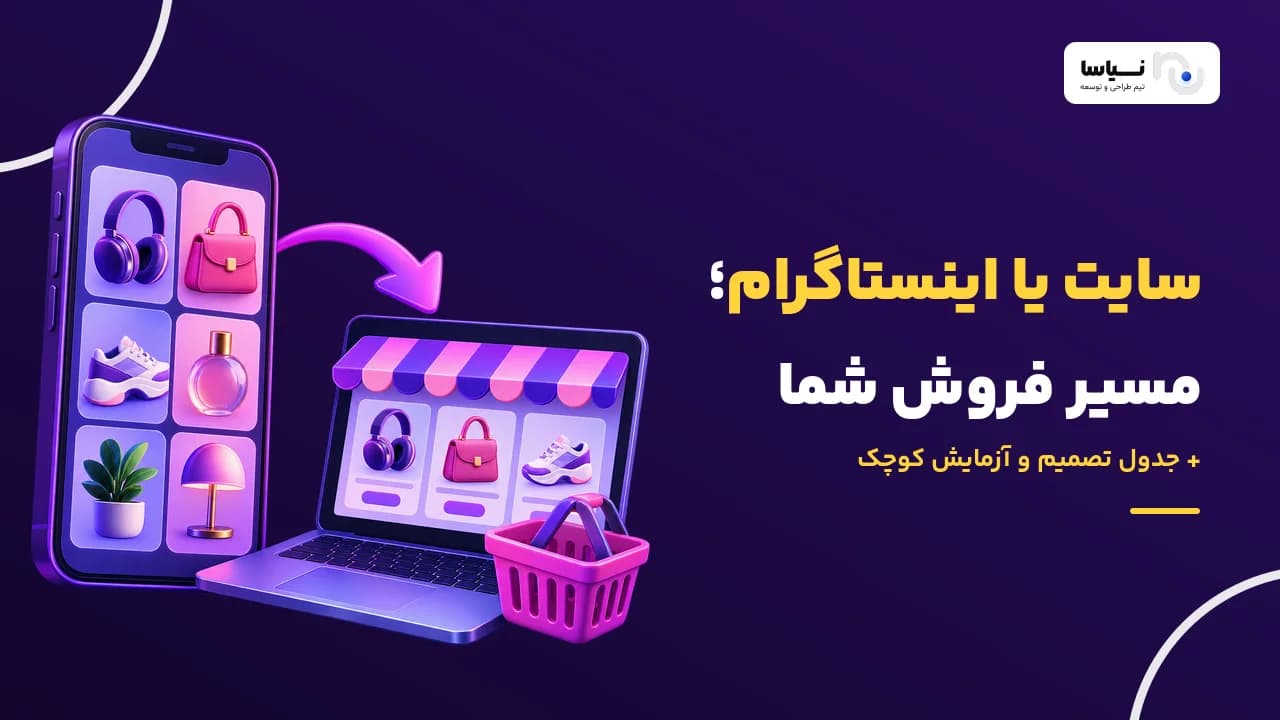
Orders are scattered across your DMs, "price?" messages go unanswered, and you're not sure a website is worth what it costs. My short answer to the website or Instagram question: as long as you can keep orders under control through conversation, your page is enough. Once errors and handling time start to climb, a website alongside the page begins to make sense.
Is a website or Instagram better for selling products?
If you're still testing demand and closing orders through conversation, staying on Instagram is the more sensible choice. But once your range grows, order mistakes pile up or reply times stretch, a website can complement the page. A fully independent store is only worth considering when you have three things in place: a defined sales process, someone responsible for maintenance and a plan for attracting customers from outside the page.
Contrary to popular belief, follower count is a poor guide here. A page with a large audience and one simple product can run perfectly well on DMs and an order spreadsheet. A small page selling items in several colours and sizes, on the other hand, gets messy much sooner.
In other words, there's no fixed order volume after which you "must" have a website. The first question I usually ask is: how long does each order take from first message to shipping, and where do the mistakes happen? The answer to that question settles the website or Instagram choice better than any number.
What different roles do a website and Instagram play in sales?
A page is mostly a place to showcase products, talk to people and build trust. A website is a place for searchable information, placing orders and tracking purchases. On your page, customers see what the product looks like in real life and can talk to you. On a website, they see the price and stock themselves and order without waiting.
So separate two jobs: attracting customers and processing orders. A website doesn't bring in visitors on its own. An active page doesn't guarantee orders get recorded properly, either. Most of the confusion I see in website-versus-Instagram discussions comes from mixing up these two jobs.
Take a hypothetical clothing store. Try-on videos and fabric close-ups do their job well on the page. But size guides, colour selection and entering a delivery address work more accurately, with fewer errors, on a website. Even so, a customer who wants advice on sizing should still be able to send a message.
And don't picture an "independent store" as bigger than it is. It means making your sales process somewhat less dependent on a single channel, not necessarily custom development. A simple store built with off-the-shelf tools can do exactly this job.
When does it make more sense to keep selling on your page?
If your product is still experimental, orders are limited or each item needs agreement before purchase, the page is the more sensible choice. At this stage, building a store may be premature: you don't yet know exactly what customers want, so you can't design a buying path around it.
Say you make handmade products. Orders are few, but each one needs details settled: material, colour, name engraving or delivery date. A shopping cart doesn't help here, because the price isn't known until the conversation ends. A simple request form that collects the details neatly will probably serve you better.
That said, staying on the page comes with three conditions:
orders recorded in one place, even a simple spreadsheet, not buried in messages;
one named person handling replies who knows who is waiting for an answer;
a way to track payment and shipping, so no order gets lost between "paid" and "shipped".
My rule of thumb is simple: if the real problem is a lack of demand, test your offer and how you present the product first. Change the price, photos, description and target audience, and watch what happens. At this stage, the website or Instagram question is still premature.
A website brings order to the sales you already have, but it doesn't bring in new customers on its own.
Which signs make a website a serious need?
When mistakes and repetitive tasks start eating your team's time, a website has become a real need. If you're wondering when to build a site for your page, watch for these signs:
the same price and stock questions over and over, so most replies are copies of one fixed text;
a lost order a customer is chasing that you can't find any trace of;
payment mismatches: a deposit that matches no order, or an order whose payment was never confirmed;
selling out-of-stock items, followed by apology calls.
Message volume alone isn't enough, though. I suggest logging, for a while, the time spent on each completed order and the number of mistakes. Lots of messages with orderly orders isn't a serious problem; few messages with constant errors is. Those two numbers move the website or Instagram decision from guesswork closer to calculation.
Products with colours, sizes or compatible parts reach this point sooner. Someone buying a spare part, for instance, needs to know which model fits their device. That information gets scattered across captions and stories, but on a product page it has a fixed home.
One practical warning. If nobody is responsible for updating stock, adding a website just creates two conflicting lists: one in the head of whoever answers DMs, and one in the site's admin panel. So before building a site, decide where your master stock record lives and who keeps it up to date.
How should you compare the cost and time of running two channels?
Compare four areas side by side: setup, maintenance, customer acquisition and day-to-day operations. A page being free to create doesn't make selling on it free, because a large share of a page's cost is team hours that never show up on an invoice.
Cost area | Instagram page | Website |
|---|---|---|
Setup | Photography and content preparation | Launch, design and initial product entry |
Maintenance | Keeping account access and security | Hosting, domain, updates and backups |
Customer acquisition | Content production and ads | The same content production, plus ads or search visibility |
Daily operations | Replying, checking payments, entering orders by hand | Adding and editing products, customer support, order follow-up |
You don't need prices to do the maths; a formula is enough. Monthly operating cost equals tool costs plus team hours multiplied by the cost per hour. If two hours of one person's day go on repetitive replies and matching deposits, those hours add up to a meaningful amount each month. Keep setup costs separate so they don't get mixed into the monthly figure.
Cost comparisons between a website or Instagram tend to make two mistakes. The first is leaving content and audience building out of the website's cost; a site without content and promotion gets no visitors. The second is treating time savings as certain before testing. Until you've seen how much less time your team actually spends with a site, that figure is just a guess.
Ask every vendor one question without fail: "After delivery, which tasks will still be manual, and who is responsible for each?" An honest answer to that question shows you the real day-to-day cost.
How do you assess data ownership and channel dependence?
Slogans about independence don't help; assess data ownership with a few checkable questions. The advantages of a website over Instagram here are real but limited: more control over order data, the ability to export it and a buying path designed your way. Still, a website doesn't make you fully independent.
Whose name is the domain registered under: yours or the vendor's?
Who holds the main admin access, and what happens if the working relationship ends?
In what format, and how often, can you export orders and customers?
Where are backups stored, and how are they handed over to you?
On the other side, a website also depends on hosting, internet access, a payment gateway and maintenance. So in the website or Instagram debate, having two channels only reduces some risks: if one channel goes down, sales don't stop entirely. For a look at these risks across the whole business, why businesses need a website and how it supports continuity offers a fuller picture.
Be strict about customer data, too. Collect only what you need for shipping and follow-up. Limit team access, and keep promotional texts separate from order status notifications, because customers gave you their number to track a parcel, not to receive ads.
Website or Instagram: which path fits your situation?
The right path depends on your demand, your main problem and how ready your operations are. That's why there's no single answer for everyone; the table below sets out three common scenarios for choosing between a website or Instagram.
Path | Demand | Main problem | Operational readiness | Next step |
|---|---|---|---|---|
Stay on the page | Uncertain or still being tested | Finding customers | One person can manage the orders | Record orders properly and test the sales offer |
Complementary website | Customers come from the page | Manual order taking is error-prone | Someone has time for stock and the admin panel | Trial online checkout for some products |
Independent store | Repeatable and from several sources | Dependence on one channel and operational volume | A maintenance owner and a multi-channel acquisition plan | Expand the store gradually alongside the page |
Note that an independent store doesn't mean abandoning the page. Even then, for many stores the page remains the most important place to showcase products. So the answer to "online store or Instagram page" is usually "both, with different roles".
The right question isn't which channel; it's what each channel is supposed to do.
If you're torn between the two, test the smaller, reversible option. Shutting down a complementary site with a handful of products is far easier than shutting down a full store. To work out which features you actually need, see the ecommerce website design guide: making the right choices before you commission one.
How do you move Instagram customers to buy on your website?
Guide them with a direct link to the exact product and a buying path you've already tested. Turning an Instagram page into a website doesn't mean your audience or posts transfer automatically. The real goal is a clear path from product showcase to placed order.
First rule: link to that product's page, not the homepage. A customer who came for a specific bag shouldn't have to search for it again. Price, stock and shipping terms must also match between the page and the site, because the smallest inconsistency damages trust.
Before inviting customers, test the purchase yourself on a phone:
choosing a colour and size and seeing the price or stock change;
shipping costs shown before payment, not after;
a failed payment, and where the order ends up afterwards;
closing the page and returning to a half-finished order.
Forms are where most purchases get stuck in this test. Principles of usable form design is a good checklist for labels, error messages and mobile keyboards. And to find the points where customers abandon the path, analysing the customer journey through to checkout helps.
On your page, spell out the concrete benefit of buying on the site: seeing stock without waiting, entering an address once and getting order status updates. Even so, hesitant customers should still have a way to get in touch. Forcing everyone onto the site loses some sales; here too, the answer to website or Instagram is "both".
Settle how shared stock works as well. Either you have a way to sync it, or you set aside a fixed share of stock for each channel. I don't recommend suddenly dropping DM orders, because then you can't tell whether customers preferred the site or simply had no other option.
How do you run a small test before investing?
Start with a small, limited, measurable version, not a full store. A purely hypothetical example: a clothing store builds a simple buying path for a few best-sellers and, before any further development, names a person responsible for stock and sets a spending cap for the test. This is the cheapest way to answer the website or Instagram question.
The order of work usually looks like this:
Record your current state: handling time per completed order, number of mistakes, number of orders and cancellation rate.
Invite customers for those products to the new path with a trackable link, so you know where each visit came from.
Define your checkout completion rate: completed orders divided by qualifying visits to the buying path.
Log separately any orders that bounced from the site back to DMs; these show you where the path gets stuck.
During the test, keep your offer and stock as stable as you can. If you run a discount, advertise and change the buying path all at once, you won't know which change made the difference.
Also set your criteria for continuing in advance, scaled to your own store's capacity. A sensible criterion is usually a combination: less time or fewer mistakes, no unexplained drop in purchases and a maintenance cost you can live with. There's no universal number that's right for everyone.
After the test, read the results like this:
If there weren't enough visits, the result is inconclusive; invite more people and try again.
If you found a specific problem with payment or product information, fix it and repeat the test.
If, after fixes, the benefit doesn't justify the cost, stop development; that's a result too, not a failure.
The output of the test should be a short decision: stay on the page, keep a complementary site or gradually expand the store. That way you answer the website or Instagram question with your own data, not with a one-size-fits-all prescription.
If you reach the expansion stage, the Niasa team starts from that same test data in ecommerce website design built around your order process. Whenever you're ready, we can walk through your order process needs together.
اگر هنوز بین ادامه پیج و ساخت سایت مردد هستید، وضعیت سفارشها و محدودیتهای تیمتان را برای بررسی اولیه با ما در میان بگذارید.
Frequently asked
4How many followers do we need before building an online store?
Follower count isn't a reliable basis for this decision. Look at how complex your orders are, how long they take to handle and whether you can maintain a store. A small page can still have plenty of difficult orders.
Will a website sell without Instagram?
It can, but you need another way to bring in customers, such as search, referrals or business partnerships. Launching a store doesn't create demand by itself.
Does turning an Instagram page into a website mean moving your followers over?
No. Your page's audience doesn't automatically become customers or site members. You need to prepare your product information and give customers a simple path and a clear reason to buy from the site.
For custom products, is an online store or an Instagram page better?
If the price and specs of each order are set after a conversation, direct checkout isn't always the best route. Showcasing samples alongside a request form and a consultation can work better than a full store.