
Most customers search for the product they want on the internet before buying it. They read other people's opinions and look for a quick, comfortable buying experience. A business that cannot be effectively present in that space is readily pushed out of the competition. So having a professional online shop does not mean merely setting up a simple website. Your site has to be designed so that it is appealing, provides an easy buying experience for the user, and can win customers' trust. But what qualities make an online shop successful? In this article we look at the most important things you should know about building and optimising an e-commerce site.
Why every online shop needs a professional website
Today's digital changes have transformed how people buy, sell and trade. A great many customers no longer depend on physical shops for their shopping; they can order the product they want from online shops at any hour of the day or night. Being present in the digital space is no longer a choice today but a necessity if businesses are to grow. A shop that has not yet entered that space will lose a large part of its potential customers.
So, to set up a successful online business, building an e-commerce site professionally is the first step. Web design on that path should be such that it not only provides a remarkable user experience but is also able to win customers' trust.
Statistics and data on the growth of e-commerce
The growth of e-commerce in recent years shows that the future of buying and selling will be settled on the internet. According to the statistics:
In recent years, online sales worldwide have grown by more than 20 per cent a year.
After the coronavirus pandemic, 97 per cent of physical shops moved towards online selling in order to survive.
More than 56 per cent of online purchases are made through mobile phones, which makes having a responsive website doubly important.
These figures show that any shop looking for growth, greater sales and the keeping of its competitive position has to be actively present in the online space.
The advantages of online selling over selling in person

An online shop puts capabilities at your disposal that are not possible in selling in person:
Access 24 hours a day: customers can buy at any moment of the day or night.
The removal of geographical limits: online selling lets you sell your products across the whole country (or even the world).
Lower costs: the cost of renting a shop, staff wages and other fixed costs fall.
The ability to market to a target: through digital advertising, you can identify and reach your target audience precisely.
Greater trust from customers: a reputable online shop, presenting users' opinions, a product guarantee and clear information, creates a greater sense of confidence in a customer.
The qualities of a successful shop site
An online shop can succeed in today's competitive market when it provides a simple, fast and dependable experience for its users. For that, a website has to have qualities that both make reaching new customers easy and bring earlier users back to the site. The most important qualities of a successful shop site are:
Responsive design
Fast loading
Easy access and a clear categorisation of products
Appealing, well-optimised content
Security and the building of trust
Below we explain each of them.
1. Responsive design
More than half of online purchases are made through a mobile. If your website does not display properly on phones and tablets, you will lose a great many customers. A responsive site adapts automatically to the size of a user's screen and gives them a comfortable, good experience.

2. Fast loading
Internet users are not patient. If your site does not load within 3 seconds or less, there is a strong chance that a user will leave it. Using powerful servers, well-optimised images and a light, efficient design increases a site's speed.
3. Easy access and a clear categorisation of products
A site's structure should be such that users can find the products they want without confusion. Clear categories, advanced search and useful filters play an important part in improving the user experience.
4. Appealing, well-optimised content
A shop site is not merely a set of products; it has to have appealing, valuable content. Product descriptions should be clear, complete and persuasive. Beyond that, using suitable keywords and SEO optimisation helps reach visitors through search engines.
5. Security and the building of trust
Users need a sense of security and confidence before buying online. An SSL certificate, secure payment methods, an electronic trust mark and the display of users' opinions are among the things that help create a sense of trust in customers.
To complete the qualities of a successful online shop, professional web design and optimising it for a better user experience matter a great deal. Given the intense competition in the online market, having a website that is at once beautiful, user-friendly and fast can be a great advantage in reaching new customers and keeping earlier ones.
How to improve the user experience (UX) in your online shop
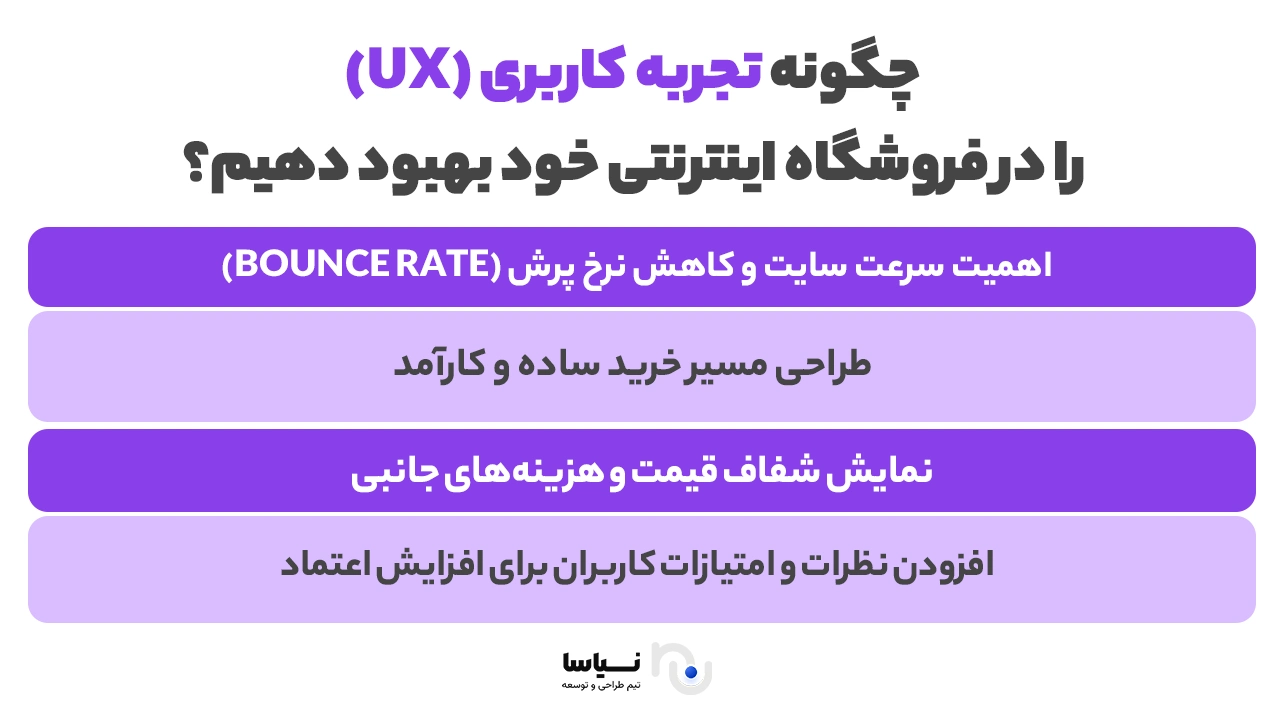
The user experience (UX) is one of the most important factors bearing on an online shop's success. From a site's speed to the buying process, every one of these details can affect users' decisions.
Why a site's speed and reducing the bounce rate matter: a site's load speed bears directly on the user experience. Slow sites increase the bounce rate, which means users leaving a site before completing the buying process. That can lead to losing customers and to a fall in sales.
Designing a simple, efficient path to purchase: the buying process should be simple and free of any complication. When users decide to buy, they should not run into any problem. A simple, smooth path to purchase makes the buying experience a positive one and lets customers complete their order readily.
Displaying prices and additional costs clearly: displaying prices, delivery costs and any additional cost precisely and clearly helps increase customers' trust. That information should be visible from the outset so that users know on what terms they are buying.
Adding users' opinions and ratings to increase trust: other users' opinions and ratings can play an important part in customers' decisions. Displaying real feedback from users about products helps create trust and makes customers feel that buying from you is a dependable experience.
The part good content plays in increasing sales
Content is one of the main pillars of reaching customers. For a shop site to be successful, it has to present suitable, well-optimised content that both reaches users and ranks in search engines.
Why product descriptions matter: precise, thorough product descriptions are one of the main factors in customers' decisions. Customers have to be made fully aware of a product's qualities and advantages so that they can make the right choice. Those descriptions should contain precise, useful detail that helps a customer be sure of their purchase.
Why a blog matters in online shops and in reaching new customers: blogs are a useful tool for reaching traffic and new customers. By publishing relevant articles, guidance and new material, you can win users' trust and turn them into loyal customers. Those articles also help improve SEO and bring in organic traffic.
The principles of SEO in a shop site's content: SEO is one of the determining factors in bringing in traffic and increasing sales. A site's content has to be precise and well optimised if it is to appear in search results. Using suitable keywords, appealing descriptions and valuable content makes your site rank better in Google and bring in more traffic.
So one of the most important steps in the process of reaching customers and succeeding in the online space is producing content that is valuable and professional. That process helps businesses reach their audience by presenting useful information and establish an effective connection with them.
Security and the building of trust: the key to success in online selling
An online shop's security is a priority for every customer. If users do not feel secure, the likelihood of their buying from a site falls. The security of customers' information, such as credit card details, has to be entirely guaranteed.
The necessity of having an SSL certificate: an SSL (Secure Sockets Layer) certificate is essential for online shops. It guarantees the security of customers' information and encrypts the data exchanged between a user and a site. That prevents hacking attacks and the theft of sensitive information and gives customers the assurance that buying from your site is safe.
Displaying electronic trust marks: marks such as an electronic trust mark or other endorsements from reputable institutions make users feel that your shop is trustworthy. They are generally displayed in a site's footer or on the payment page and help strengthen customers' trust.
Returns policies and customer support: returns policies and effective customer support are vital in creating a sense of confidence in users. If customers know that they can return their product or draw on customer support should a problem arise, they will buy far more readily.
In summary
In this piece we have noted that a professional online shop needs, in order to succeed, a design and qualities that provide an excellent user experience and win customers' trust. Among the most important of those qualities are responsive design, fast loading, security and well-optimised content. Precise, appealing content, alongside the capabilities that win trust such as customers' opinions and guarantees, is likewise among the key factors in reaching customers and keeping them.