
Choosing the right platform for an online shop
Poor design and user experience (UX)
Technical and infrastructure problems (hosting, security and speed)
Sourcing and managing stock
Marketing and attracting targeted traffic
Winning customers' trust and building a brand's credibility
Keeping customers and building loyalty
Intense competition and standing out in an online market
Updating continuously and keeping pace with a changing market
Legal and tax matters in selling online
In today's digital world, consumers' buying behaviour has changed strikingly. As internet access has spread and smartphone use has grown, people are more inclined than ever to meet their needs through online shops. That change in the pattern of buying has created a great many opportunities for businesses to offer their products and services to a wide range of customers without needing a physical shop. Building an online shop is no longer a luxury or an afterthought; it has become a fundamental necessity for survival and for competing in the market. Even traditional businesses have concluded that they have to enter the online world in order to keep their share of the market. Setting up an online shop also brings advantages such as lower overheads, reaching new customers, selling around the clock and analysing customer behaviour precisely.
Setting out on that road comes with challenges, though. Contrary to what some imagine, building an online shop is not limited to designing a website. It is a combination of technical, marketing, legal, financial and customer experience questions that, managed badly, can lead to failure. In this article we look at the most important challenges of e-commerce web design and offer practical, workable solutions to each, so that the road to setting up a successful online business becomes clearer and more practical.
Choosing the right platform for an online shop
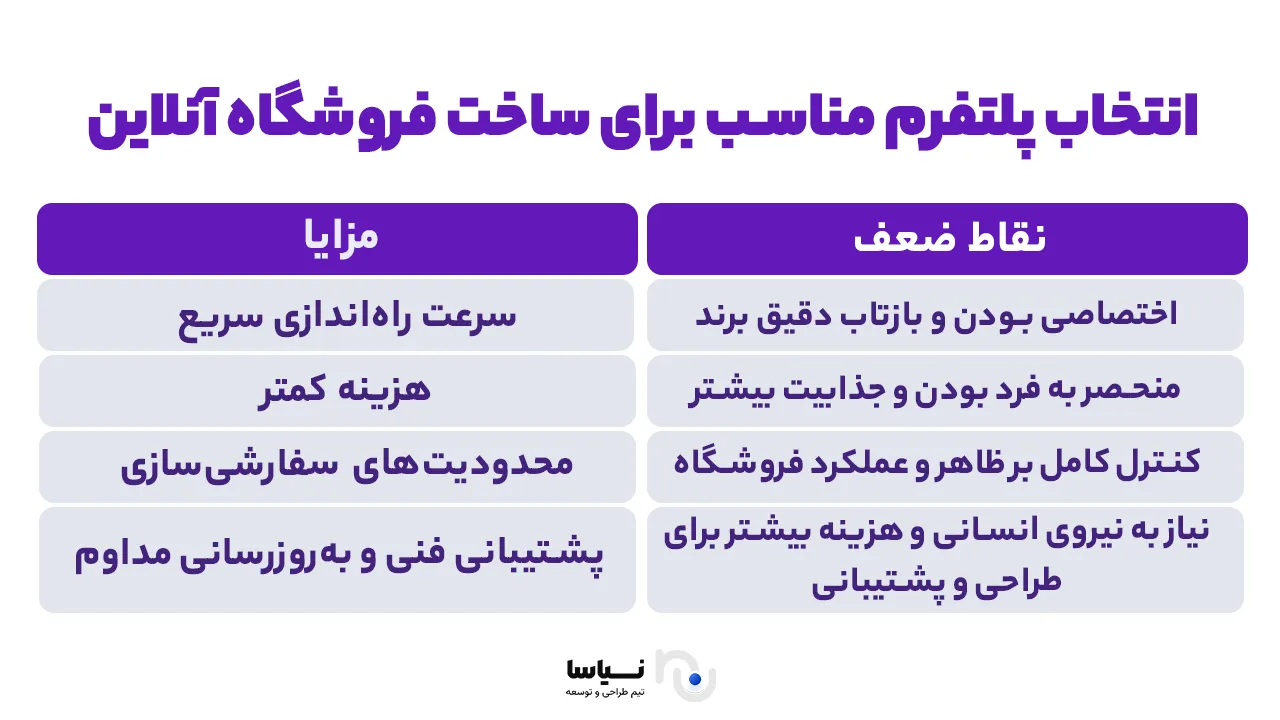
One of the first and most important decisions on the road to building an online shop is choosing the platform or shop management system. The wrong choice at this stage can lead to extra costs, technical problems and even the need to redesign the shop later. Every business should choose a platform that matches its present and its future needs.
The solution: comparing and choosing knowingly among the leading platforms
To choose the best option, we first have to become acquainted with the kinds of e-commerce platform. Broadly, online shop platforms fall into two main groups: hosted platforms and self-hosted platforms.
Hosted platforms (such as Shopify or Iranian shop builders):
These platforms suit people without much technical knowledge who want to set up their shop quickly. Their advantages include simple design, technical support, automatic updates and ready-made payment gateways. Against that, they have limits on customisation and on building particular capabilities and usually charge on a subscription.
Self-hosted platforms (such as WooCommerce, PrestaShop or Magento):
These options give users freedom and unlimited capability. You can change the themes, the plugins and even the site's core code as you need. They suit businesses that have a technical team or intend to grow a shop at scale. In return, managing the hosting, the security, the support and the maintenance all fall to the shop's owner.
If you are new to this or have a limited budget, you can start with an Iranian shop builder such as Shopfa, Portal or Sazito. But if your aim is a professional shop with a great deal of room to grow, using WooCommerce on WordPress is one of the best choices, because it has both a large user community and abundant learning resources and plugins.
In the end, the choice of platform should be made on criteria such as budget, technical knowledge, kind of product, volume of sales, need for customisation and a view of the future.
Poor design and user experience (UX)
Many online shops, for all their good products and competitive prices, fail to reach or keep customers purely because of poor design and a weak user experience. A user arriving at an online shop spends only a few seconds deciding whether to stay or leave. If the site's design is complicated, confusing or unappealing, they will probably leave it without buying.
Why does the user experience matter?
The user experience means, simply, how a user feels about and perceives their dealings with a site. If the buying process is simple, the product information is clear and the site's various sections are easy to reach, the user engages with the site and the likelihood of a purchase increases. But if a user becomes confused in finding a product or completing a purchase, the likelihood of an abandoned basket and of them leaving the site is very high.
The solution: user-centred design principles, A/B testing and analysis of user behaviour
Keeping the design simple and orderly:
A site's design should be simple, clean and understandable. Avoid too many colours or unsuitable typefaces. The structure of the product pages, the categories and the main menu should be clear and orderly.
A/B testing to refine pages:
With A/B testing, two different versions of a page (a product page or a payment page, say) can be compared to establish which performs better. That means design decisions are taken on the basis of data and users' real behaviour rather than on assumptions.
Using tools that analyse user behaviour:
Tools such as Hotjar or Microsoft Clarity let you see where users click, where they stop and which pages they leave. That data helps you identify and improve the weak points of the user experience.
The site being responsive on mobile:
Given that many users come to an online shop on a phone, a site has to be fully optimised for small screens. Responsive design is no longer a choice but a necessity.
Reducing the steps to purchase:
If the buying process is long or complicated, the rate of abandoned baskets increases. The steps to purchase should be simplified as far as possible, a guest checkout enabled and long forms avoided.
Technical and infrastructure problems (hosting, security and speed)
The technical infrastructure is the backbone of any online shop. Even the best design and the strongest marketing cannot make up for weak hosting, weak security or a slow-loading site. Today's users are very impatient; if a site does not load within a few seconds or gives an error during a purchase, they will readily go to your competitor.
Weak or incompatible hosting
Using cheap or non-standard hosting services usually makes a site slow, causes frequent outages and even loses data. Some hosts are also incompatible with particular e-commerce systems and cause difficulties in installing plugins or growing a shop.
A slow site
According to the figures, if a page takes more than 3 seconds to load, more than 50% of users leave the site. Slowness not only has a negative effect on the user's experience, it also lowers your SEO ranking.
Weak security and the risk of a breach
Online shops store sensitive information such as users' personal and financial data. If a site is not secure, your reputation is damaged and you may face legal or financial penalties.

The solutions
Choose hosting suited to an online shop:
Use companies offering services and support particular to online shops. The hosting should be suitable in bandwidth, in speed and in scope for upgrading.
Use a content delivery network (CDN):
CDNs such as Cloudflare increase a site's load speed, reduce the use of hosting resources and protect against DDoS attacks.
Optimise images and code:
Using images of an optimal size, removing superfluous CSS and JavaScript and using browser caching all increase speed.
Install an SSL certificate:
Enabling SSL (https) is essential; it both helps security and matters for SEO. Browsers even warn users if a site has no SSL.
Update regularly and use reputable plugins:
Always keep the content management system and the plugins up to date so as to prevent security vulnerabilities. Avoid installing unknown or unsupported plugins.
Take regular backups:
Always keep a backup of your site so that you do not lose your data if something goes wrong.
Sourcing and managing stock
One of the serious challenges in setting up and running an online shop is controlling stock precisely and managing the supply chain. Many shops, new and even experienced, meet problems such as stock suddenly running out, orders taken for products not in the warehouse, or delays in dispatch, all of which can leave customers dissatisfied and reduce trust in a brand.
No coordination between online sales and the warehouse
In some shops, stock is updated by hand or with a delay. That means a customer orders something that is not in fact in the warehouse. Such an error is not only costly, it also calls a shop's credibility into question.
Unreliable suppliers
Depending too heavily on one or two suppliers may break the supply chain when demand rises or in unusual circumstances (a holiday period, or problems with imports).
A wide range and difficult control
Shops with a wide range of products, if they do not use a proper management system, very soon run into disorder, incorrect stock levels and invalid orders.
The solutions
Use inventory management software:
Tools such as Forooshgahyar, Sepidar, Holoo or web-based ERP software make it possible to control stock in real time, record goods in and out, warn when stock runs low and even connect to the online sales system.
Connect the online shop to the warehouse automatically:
Many platforms or plugins let the online sales system connect to the warehouse system so that stock levels are updated precisely and in real time.
Set up a stock-level warning system:
By setting a minimum stock level for each product, you are notified as soon as it is reached and can act quickly to restock.
Work with several dependable suppliers:
For key, best-selling products it is better to have more than one supplier, so that if one runs into difficulty the supply is not interrupted.
Use dropshipping for some products:
In this model you are responsible only for taking the order, and the supplier dispatches the goods. It is useful for reducing the need for warehousing and increasing the range of goods, although a dependable supplier has to be chosen.
Marketing and attracting targeted traffic
Building an online shop is only the start of the story; without visitors there will be no sales. Many online shops fail to reach customers because they have no proper marketing strategy. Simply setting up a site and putting products on it does not lead to sales; users have to be guided to the site — and not just any users, but potential, targeted customers. Some shops advertise on social networks or on Google without a plan, in a scattered way. Those methods may create traffic, but they do not lead to sales, because the users are not targeted. Advertising on Google, Instagram or other platforms without precise targeting creates a great deal of cost without an adequate return. Many shops rely on paid advertising alone and pay no attention to SEO, to producing content or to attracting users organically, when organic traffic is more durable, better targeted and more economical.
The solutions
Build a multi-channel digital marketing strategy:
A combination of paid advertising (Google Ads, Instagram, pay-per-click) and organic methods (SEO, a blog, influencer marketing) should be used. The aim is to be in touch with your target users in different places at different times.
Identify your target audience and build a customer persona:
By understanding the characteristics of your potential customers (age, gender, interests, location, needs), you can target your marketing content more precisely. A cosmetics shop, for instance, needs different advertising from a sports goods shop.
Use SEO to attract organic traffic:
Keyword research, optimising product pages, producing relevant content on a blog and internal linking are effective tools for reaching users through Google.
Use social networks with purpose:
Activity on Instagram, Telegram and even platforms such as TikTok (for a younger audience) should follow a defined plan: producing content regularly, engaging with users, running competitions and using stories and live broadcasts.
Email marketing for following up and winning back previous customers:
Sending a newsletter, announcing discounts or reminding people of an abandoned basket by email contributes a great deal to a higher return rate and greater sales.
Use retargeting:
Using tools such as Google Ads or the Facebook Pixel, users who have visited your site before can be targeted with advertising again. That gives a higher conversion rate.
Winning customers' trust and building a brand's credibility
In online selling, where a customer cannot touch, test or genuinely see a product, building trust is the key to success. If users do not trust your shop, no purchase will happen even with the best prices and the widest range. Building trust matters not only at the first sale, it also plays a vital part in a customer coming back and in their recommending your brand to others. Sites without official marks such as the Iranian e-trust seal, without a landline number, without full information about the seller, without a returns policy and without secure payment create a sense of distrust in an audience's mind.
A crowded appearance, an amateurish design, poor-quality images or inconsistency in colours and typefaces convey to an audience, without their consciously noticing, that this site is not professional and that buying from it may be risky. Users like to know other people's experience of a product and of a shop's service before buying. In the absence of such feedback, a purchase usually does not happen.
The solutions
Obtain and display the e-trust seal and any legal permits:
Placing these marks in the site's footer or in the "about us" section conveys formality, security and transparency.
Provide full contact details and real support:
Showing a physical address, a landline number and a WhatsApp or live chat channel assures users that if something goes wrong they can follow it up with the shop.
A professional design and a user-friendly interface (UI/UX):
A site's appearance should be clear, orderly, beautiful and trustworthy. Attention to colour, good-quality images, a readable typeface, a simple path to purchase and precise search filters create a positive experience for a customer.
Show customers' reviews and ratings on products:
Enabling user reviews on product pages helps new customers buy with greater knowledge and confidence. Even negative feedback (within reason) can be useful if it is met with a professional reply.
Use social networks to show transparency and engage with users:
Regular activity on Instagram, showing behind the scenes at the shop, showing customers' satisfaction, posting pictures of the packaging and even answering comments all strengthen a brand's human face.
Create an "about us" and a "frequently asked questions" page:
An honest introduction to the shop, its values, its team and the story of how it came about, together with answers to users' recurring questions, plays a large part in increasing trust and transparency.
Keeping customers and building loyalty
Many online shops focus mainly on reaching new customers, but building loyalty among existing customers is one of the most important factors in lasting success in online business. Reaching a new customer usually costs more than keeping an existing one, and a loyal customer can recommend your brand to others, buy again and even play a direct part in a business's growth.
Ignoring the experience after a purchase
Some shops have no further contact with a customer once the goods have been sent. No follow-up, no satisfaction survey and no answer to requests after a purchase cool the relationship and reduce trust.

No reward system for loyal customers
If a customer buys from you several times but does not feel that they matter particularly to the shop, they may over time go to a competitor. The absence of a loyalty scheme or of particular discounts leaves a customer without motivation.
Poor support and responsiveness
Weak support, late replies or ignored messages destroy trust and lead people to leave a brand more than anything else. Even where the buying experience was good, not attending to problems after a purchase undoes all the work.
The solutions
Stay in touch with the customer after a purchase:
Sending a message of thanks, following up on the buying experience, asking for feedback and offering a discount code for a future purchase are among the simplest ways of keeping in touch.
Set up a loyalty scheme or a customer club:
By awarding points for each purchase, giving gifts on particular occasions, or offering special discounts to loyal customers, you can create a sense of being valued.
Professional, available support:
Using tools such as live chat, answering on WhatsApp, a ticketing system or regular telephone support means a customer feels secure even if something goes wrong.
Analyse customers' behaviour and make personalised offers:
By looking at purchase history and interests, particular offers can be made that match a customer's needs exactly. This is very effective in increasing the rate of return and of sales.
Encourage people to share their experience on social networks:
Asking a customer to share their buying experience and giving a discount code for referring friends is an effective way of extending a brand through customer loyalty.
Intense competition and standing out in an online market
In the crowded, competitive space of online shops, simply being present is not enough. In almost any field you enter there will be competitors who have been working for years, have made their brand known and hold a share of the market. In those conditions, if you cannot create a real distinction, you will probably be lost among the mass of shops.
Shops that enter the market relying on "low prices" or "a wide range" alone very soon meet heavy competition, because those advantages are readily copied. Some businesses copy their design, their content and even the way they operate from other shops. As a result they not only have no identity, they cannot win an audience's trust or interest either. Shops that do not know precisely whom they are for, what need they meet and what value they offer become confused in their marketing message, in their products and even in their pricing.
The solutions
Create a competitive advantage that cannot be copied:
Rather than competing on price or delivery speed alone, focus on things such as the quality of your service, particular packaging, a distinctive user experience, expertise in a particular field, or a human relationship with the customer.
Build a brand with a defined voice and identity:
Your brand should have a voice that an audience recognises. From the logo design to the way captions are written, everything should accord with your brand's identity and convey a particular feeling.
Focus on a niche market:
Rather than selling everything to everyone, it is better to focus on a small but defined market. Rather than a "women's clothing shop", for instance, set up a shop only for formal manteaus or for sustainable clothing.
Offer a different customer experience:
Provide a service that stays in the mind: a handwritten note with a delivery, immediate support, or even a small gift with an order.
Analyse competitors and the market continuously:
Using tools such as SimilarWeb, Google Trends or an analysis of competitors' behaviour on Instagram, follow the market's trends continuously and adapt.
Updating continuously and keeping pace with a changing market
The online market is changing quickly, and online shops that cannot keep pace with it will soon be out of the competition. From changes in customers' preferences to advances in technology and new rules, all of it takes continuous attention and adaptation.
Slowness in updating products and services
Some shops do not apply changes to their site quickly when new products appear or rules and regulations change. That delay not only weakens the user's experience, it also lets faster competitors get ahead of you.
Not keeping pace with changes in technology and innovation
New technologies such as artificial intelligence and augmented reality (AR) or automation tools such as chatbots can improve the buying experience strikingly, but an online shop that cannot use them falls behind.
Ignoring changes in consumer behaviour
Customers' behaviour online is always changing. At one point customers may be very inclined to buy on a phone and at another to move towards buying on a desktop. Shops that ignore those changes will not succeed in satisfying their customers.
The solutions
Update your products and your site's information continuously:
Products should be updated regularly. If something has sold out, say so immediately. Price, features and product descriptions should also always be accurate and up to date.
Use newer technology:
Using technologies such as chatbots for 24-hour support, intelligent product recommendations and even augmented reality for viewing products can set your shop apart from your competitors.
Analyse and understand changes in customers' behaviour:
Using analytics tools such as Google Analytics or Hotjar can help you examine users' behaviour at different times and adjust your shop to their new needs.
Respond to changes in laws and regulations:
Make sure your site accords with new rules such as data protection law (GDPR) or sales tax law and keep up with them.
Be flexible in pricing and in special offers:
To keep pace with changes in the market, change your offers and discounts. Seasonal updates, occasion-based discounts or special sales can also help you stay competitive.
Legal and tax matters in selling online
Alongside their work in stock management, advertising and reaching customers, online shops also face legal and tax challenges. Failing to observe the rules may lead to heavy penalties or legal difficulties. Tax matters can also be complicated, particularly in selling digital goods or products internationally.
Not knowing e-commerce law
For an online shop, knowing national and international law, particularly the law relating to e-commerce, is essential. Every country or region may have its own rules that have to be observed carefully. Not knowing them can create serious problems.
The complexity of tax and of sales tax law
In many countries, the tax rules relating to online selling are complicated and include matters such as value added tax (VAT) or sales tax. These may be complicated for international and even for domestic shops, particularly where different goods carry different rates of tax.
Intellectual property questions
Online shops have to observe the law relating to copyright and intellectual property for their own products and for those of third parties. That may include copyright in images, trade marks and particular designs.
The solutions
Consult lawyers who specialise in e-commerce:
To observe the law precisely, it is better to take advice from lawyers who specialise in e-commerce and digital law. They can help you with the particular rules of your country or region.
Use accounting software to calculate tax:
Using accounting software that calculates tax and issues invoices automatically can make the tax process simpler.
Observe copyright and intellectual property law carefully:
Make sure that all your shop's content (images, videos, trade marks) is legally yours to use and that you are not infringing copyright. If you use content belonging to other brands, always obtain the necessary permissions.
Keep abreast of changes in the law:
Watching changes in laws and regulations continuously, particularly in tax and e-commerce, helps you stay up to date and prevents possible penalties.
In summary
In the end, succeeding in building and running an online shop takes complete preparation, strong strategies and the ability to keep pace with a range of challenges. You have to be ready in every aspect of your online shop: stock management, refining the user experience, advertising, legal and tax matters and competing in the market. Finally, a few points are worth bearing in mind:
Examine the market and customers' needs carefully:
Before you begin, analyse the market and customers' needs carefully. That helps you set out in the right direction from the start.
Create a distinctive user experience:
A site's design should be simple, appealing and user-friendly. Customers should be able to find the products they want readily, and the buying process should be quick and easy for them.
Guarantee the security of data and payments:
Your site's security should be a priority. Using security protocols such as SSL and secure online payments is essential to keeping customers' trust.
Good, up-to-date content:
Product content should be accurate and up to date, and the images and descriptions should show each product's qualities well. That helps build trust and increase sales.
Use analytics tools to follow performance:
Using analytics tools such as Google Analytics helps you identify customers' behaviour and improve your shop on the basis of that data.
Look after your relationships with customers:
Offering excellent support and staying in touch with customers continuously can help you keep them and increase the rate at which they return.