
What is domestic hosting?
What are the advantages of domestic hosting?
What is foreign hosting?
What are the advantages of foreign hosting?
7 differences between Iranian and foreign hosting, with a comparison table
Choosing between domestic and foreign hosting is a little like deciding whether to buy an Iranian or a foreign product of similar quality. Sometimes your heart inclines towards the foreign brand, but the lower price of the Iranian option tempts you. When you reach the stage of choosing a web hosting service, having passed obstacles such as the host's operating system and the kind of hosting, you face a new challenge: choosing between domestic and foreign hosting. In this article, by looking carefully at 7 fundamental criteria, we help you understand whether domestic or foreign hosting is better. Stay with us so that you can decide properly.
What is domestic hosting?
Domestic hosting means website hosting services provided within the country by Iranian companies. With this kind of hosting, your website's data and files are stored in data centres located in Iran. It suits websites serving an Iranian audience and is a good choice where local support and quick contact with the provider are needed.
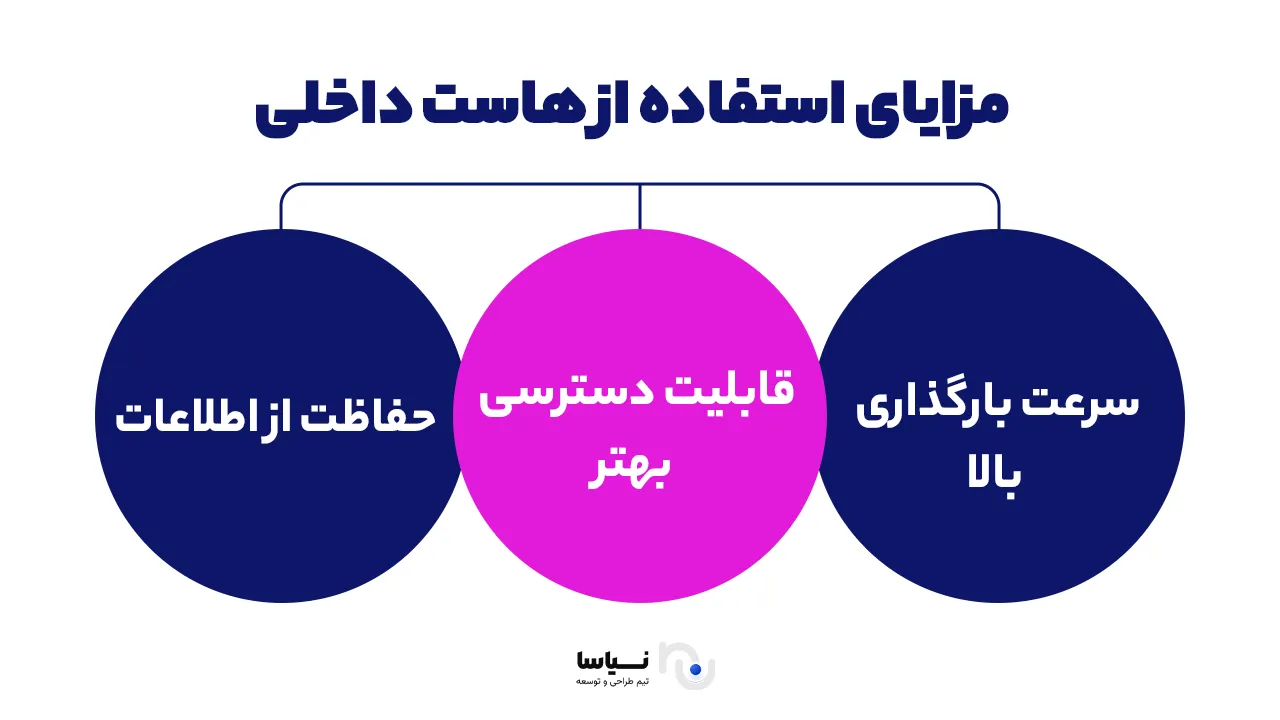
What are the advantages of domestic hosting?
Domestic hosting has a great many advantages that make it very useful and suitable for businesses and websites focused mainly on the Iranian market. Below we set out some of the most important:
1 – High speed and easier access
One of the greatest advantages of domestic hosting is a higher page load speed, because the servers are within Iran and closer to Iranian users. That reduces ping time and makes web pages load faster.
2 – Local support and service
With domestic hosting, you can draw on local support and service. That means that if a technical problem arises or you need advice, you can readily contact the support team during Iranian working hours.
3 – Lower cost
Domestic hosting is usually cheaper than foreign hosting. That is because setting up and maintaining servers within the country costs less, and it can be a suitable choice for a young business or one with a limited budget.
4 – Greater stability against sanctions
Because it falls under the country's own oversight and rules, domestic hosting is not vulnerable to sanctions and international restrictions. That matters a great deal for businesses that may be exposed to sanctions and to restrictions on reaching foreign services.
5 – Better access to Iranian data
If your website serves Iranian users, storing your data on a domestic host can improve performance and accord with the country's privacy laws. That can contribute to users' satisfaction and to protecting personal data.
6 – Compatibility with domestic laws and regulations
Domestic hosts are generally more compatible with national laws and regulations on protecting users' data and information. That matters particularly for websites that have to observe the laws governing personal data.
Taken together, domestic hosting can be an economical and practical option for websites whose main audience is in Iran.
What is foreign hosting?
Foreign hosting means website hosting services whose servers sit outside Iran's borders, in other countries' data centres. This kind of hosting suits websites that need an international or a particular audience and draws on stronger infrastructure and more advanced technology. Foreign hosts generally have better speed and performance and offer more for high traffic and better data management than domestic hosts.
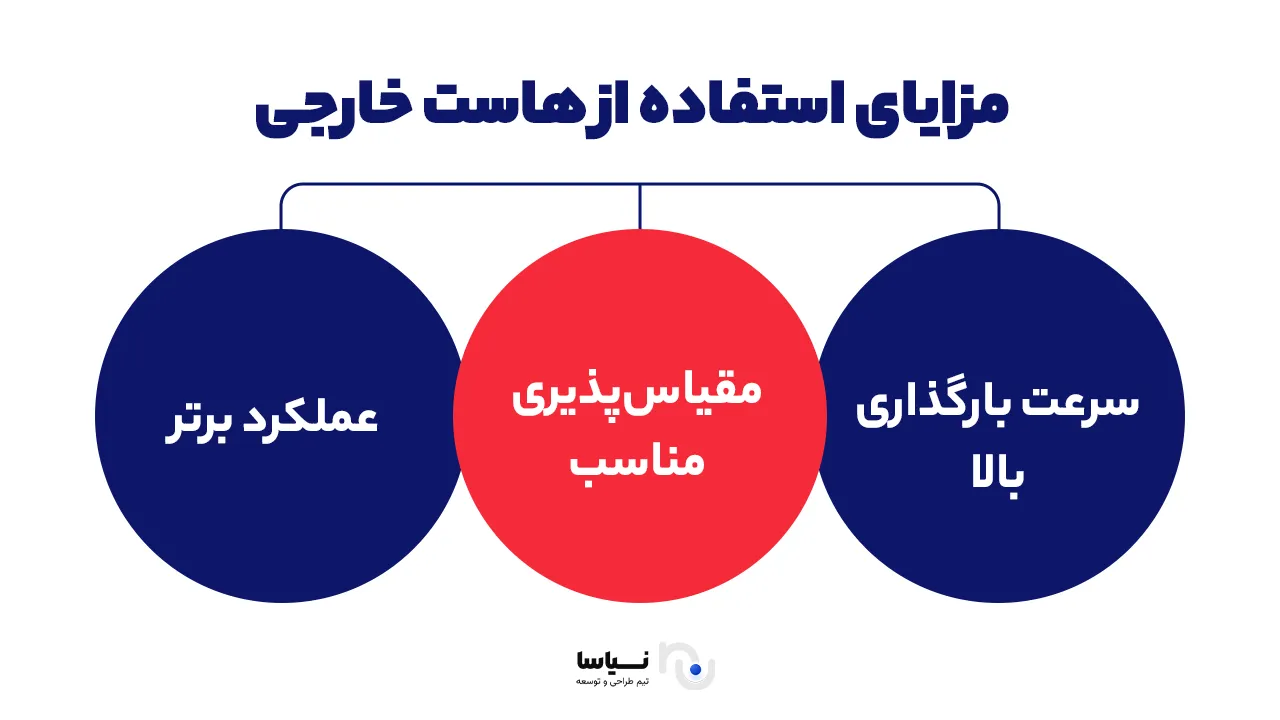
What are the advantages of foreign hosting?
Foreign hosting has its own advantages, which may suit businesses with an international audience or a need for higher performance. Below we set out some of the most important:
1 – Higher speed and performance
Foreign hosting servers generally have more powerful, more up-to-date hardware that can perform better than domestic hosting. That means a website loads faster and there is less delay for users reaching the site from different countries.
2 – More bandwidth and unlimited traffic
Most foreign hosting providers offer packages with high or unlimited bandwidth, which lets you readily run busy websites with high traffic. That is very useful for sites with heavy content or a great many users.
3 – More powerful hardware
Foreign hosts generally have access to more advanced, higher-capacity hardware. Foreign servers may have larger memory (up to 512 gigabytes) and more powerful processors, which can have a considerable effect on how your site performs.
4 – Greater stability and security
Foreign hosting companies generally use advanced infrastructure to secure and stabilise their services, including anti-DDoS systems, regular backups and multiple data centres in different parts of the world, which helps reduce the likelihood of a site going down.
5 – Access to newer technology
Foreign hosting providers generally have access to newer, more up-to-date technology and can offer additional capabilities such as cloud servers, a CDN (content delivery network) and scalability. That can readily help a business grow and a site develop.
6 – Professional, 24/7 support
Foreign hosting companies generally offer professional support around the clock. Their support teams generally have a great deal of experience in solving technical problems and can help you in the shortest possible time.
7 – Servers in a range of geographical locations
Choosing a foreign host lets you have servers in different geographical locations. That helps your site load quickly and more effectively for users in different countries.
8 – Competitive prices and a range of options
Foreign hosting is generally offered at competitive prices and in a range of packages, which lets you choose the host that suits your needs and your budget. Because of the high competition, some foreign hosting providers have good prices that can be an economical choice for a large business.
In the end, foreign hosting is a suitable and effective option in particular for websites with an international audience or a need for greater resources.
7 differences between Iranian and foreign hosting, with a comparison table
The differences between Iranian and foreign hosting have become an important matter for anyone wanting to set up a high-quality, well-performing website. In this section we compare the 7 main differences between domestic and foreign hosting so as to help you choose the best option for your needs.
1 – The difference between Iranian and foreign hosting in bandwidth
One of the important differences between domestic and foreign hosting is bandwidth capacity. Broadly, internet costs in Iran are higher than in many developed countries, so Iranian hosts generally charge more for high traffic. Where many foreign hosting providers offer unlimited bandwidth, Iranian hosts generally have limits here and charge more for additional traffic. Put another way, with foreign hosting you will generally have no difficulty with bandwidth limits, whereas with domestic hosting there are limits in this respect.
2 – Comparing ping time, or server response time
Ping time, or server response time, is the time between a user's request being sent and a response being received from the server. Many regard it as a measure of a hosting service's speed and quality. The assumption is that because an Iranian host sits within the country, the distance between the server and Iranian users is smaller, so response time or ping on an Iranian host should be faster than on a foreign one. That assumption is not always correct, however. In fact, the quality of the infrastructure and the hardware has a considerable effect on ping time. If an Iranian host uses weak equipment or inefficient infrastructure, its response will be slower than a foreign host with powerful infrastructure. Broadly, if your website has a great many Iranian users, an Iranian host can be a suitable choice, but if high quality and speed matter for foreign users too, a foreign host may be the better option.
3 – Is Iranian or foreign hosting more stable?
Stability is one of the important criteria in choosing a host, because websites need high, uninterrupted uptime. In examining the differences between Iranian and foreign hosting, one of the things that can affect a website's stability is disruption to the internet within the country.
If international internet access in Iran is cut off, websites using foreign hosting may be disrupted or become unreachable. Websites using Iranian hosting, by contrast, being directly connected to domestic infrastructure, may remain stable in those circumstances. Broadly, a host's stability depends greatly on its infrastructure and on the hosting company. With an Iranian host on good infrastructure, good stability can be expected. In particular circumstances, though, such as international internet being cut off, foreign hosts may run into difficulty.
4 – Hardware on Iranian or foreign hosting
In choosing a host, hardware is one of the most important factors in guaranteeing a server's performance. Foreign servers generally use up-to-date, powerful, high-capacity hardware. Some foreign servers offer up to 512 gigabytes of memory, for instance, while Iranian servers generally operate around 128 gigabytes. Foreign hosts may therefore perform better in loading pages and answering requests. Beyond that, sanctions create difficulties in buying good-quality parts and in obtaining hardware support from manufacturers in Iran. Because of these constraints, Iranian hosts generally use cheaper hardware that may be of lower quality and durability. In choosing between Iranian and foreign hosting, then, good, up-to-date hardware counts as one of the notable advantages of foreign hosts.
5 – The main difference between Iranian and foreign hosting
In choosing between Iranian and foreign hosting, one of the main differences is cost and the kind of investment involved. To begin with, there are two different kinds of cost in buying hosting: capital cost (the initial cost of buying or renting a server) and running costs (paid monthly to maintain the service). In Iran, most hosting companies rent their servers in order to save money. Those rentals are usually of servers with more powerful hardware outside the country. In terms of initial cost, then, foreign hosting can be more economical, because renting a server abroad is cheaper than buying one within the country. Ancillary costs over the long term will therefore be lower with foreign hosting.
With Iranian hosting, on the other hand, because of the constraints on buying hardware and the higher cost of some services, ancillary costs will broadly be higher. If you want to set up a high-performing website with lower costs over the long term, then, it is better to choose foreign hosting.
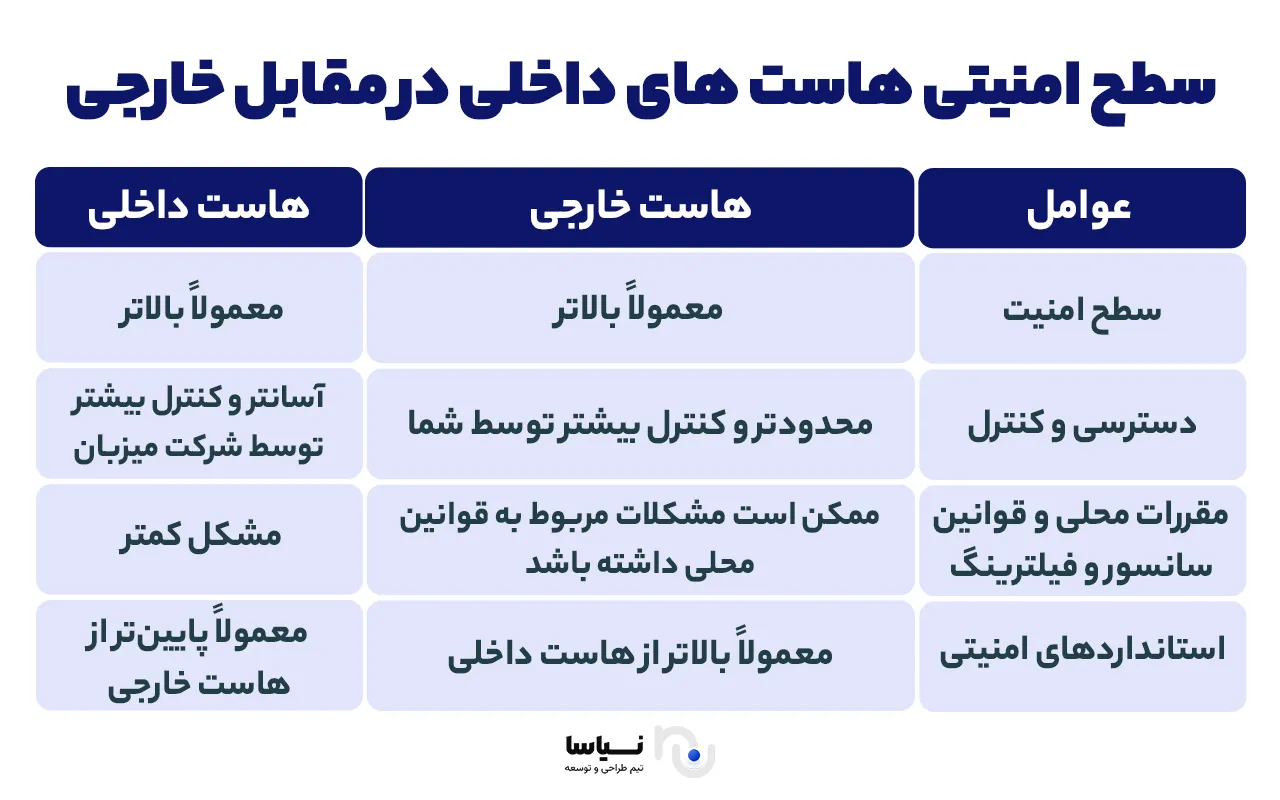
6 – The difference between Iranian and foreign hosting in security
Security is one of the important questions in choosing a host. Many people believe that Iranian hosting is better in terms of security because it is close to the country's laws and because domestic servers are under domestic control. It should be borne in mind, though, that reputable hosting companies, in the country and abroad, generally take regular backups of their users' data and apply a great many security measures. The likelihood of losing data through server failure or a hack has therefore been reduced on almost all hosts.
One important difference, though, is that foreign hosts may be exposed to legal questions concerning sanctions. If you have a government, financial or social website that has to observe the country's domestic laws, using Iranian hosting may be better because of sanctions and legal oversight. For websites holding sensitive or legal information, domestic hosting can also provide better security against external threats.
7 – Comparing SEO on Iranian and foreign hosting
SEO, or search engine optimisation, for attracting more traffic from search engines such as Google, depends greatly on a website's page load speed and on the user's experience. In that respect, Iranian and foreign hosting may differ in page load speed. Broadly, foreign hosts, using advanced servers and up-to-date technology, can offer higher page load speeds. That can help improve a site's ranking in Google's search results. If your site's main users are mostly in Iran, on the other hand, domestic hosting can be more useful for improving load speed and the user's experience within the country.
Another important matter is access to the server and to the country's IP addresses. If most of your site's visitors are from Iran, for instance, using Iranian hosting can give users a better experience. If your site has visitors from a range of countries, on the other hand, foreign hosting can give international users better speed.
Iranian hosting or foreign hosting | Iranian hosting | Foreign hosting |
Load speed and continuous uptime | * |
|
Free of the risks associated with sanctions | * |
|
Powerful hardware |
| * |
More bandwidth and traffic |
| * |
Remarkable port speed |
| * |
Low price | * |
|
Free of copyright restrictions | * |
|
Information security | * | * |
A website's stability when international internet is cut off | * |
|
A website's stability when international internet is cut off, using a foreign IP |
| * |
In summary
In the end, choosing between Iranian and foreign hosting depends on your website's particular needs and characteristics. If your website has mostly domestic visitors and you need lower costs at the outset, Iranian hosting can be a suitable option. If your website has grown and needs greater speed and stability, or has international traffic, foreign hosting may be the better choice. In either case, bear in mind that both kinds of hosting have their own advantages and drawbacks and that, considering your own needs, you can make the best choice for your specialist website design .
Frequently asked questions
1 – What is the difference between Iranian and foreign hosting?
Foreign hosting has more advanced hardware and greater processing power and, beyond that, unlimited bandwidth and higher speeds. Iranian hosting, by contrast, is generally cheaper and, with continuous uptime and good security, performs better for sites with an Iranian audience because it is close to domestic users. Iranian hosting also has no copyright restrictions.
2 – Should we choose Iranian or foreign hosting for a website?
The choice of host depends on the kind of website and its needs. If your website is a government one, or holds sensitive national information such as news or university data, Iranian hosting will be the better option. For websites with high traffic, or needing more hardware and resources, foreign hosts with their support for high bandwidth and greater processing power will suit better.
3 – Is Iranian hosting cheaper than foreign hosting?
Broadly, Iranian hosting is cheaper than foreign hosting because domestic hardware is available and costs are lower. Foreign hosting, with its more advanced capabilities and hardware, generally costs more.