
In the process of designing and building an app, one of the first and most decisive choices is the project's technical route: native development, or a cross-platform approach. That choice not only settles how the code will be written, it also has a direct effect on development time, on costs, on how the app performs and even on the user's experience. In recent years, frameworks such as Flutter and React Native have brought considerable advantages to cross-platform development, but that does not mean native development has been superseded or lost its value. Each approach has its own strengths and limits, and choosing between them is a strategic, design-led decision more than a technical one. In this article we look closely at the differences, the advantages and the appropriate uses of each approach, so that the choice becomes clearer for product teams, start-up managers and clients thinking about building an app.
What is a native app?
Native apps are written directly for one particular operating system: for Android in languages such as Java or Kotlin, and for iOS in Swift or Objective-C. In this approach, developers use each platform's own official tools and APIs to build an app that interacts directly with the hardware and the operating system. The main advantage of a native app is complete access to the operating system's resources and capabilities. The result of that deep interaction is faster performance, smoother animation, more precise access to sensors, camera, GPS and so on, and complete freedom in designing the UI. The main drawback of this route, though, is greater cost and longer development, because each platform needs its own team or at least its own separate code. Maintaining and updating two separate versions also takes more careful coordination.
What is a cross-platform app?
Cross-platform approaches such as Flutter and React Native, by contrast, let developers write the code once (usually in a language such as Dart or JavaScript) and build an app that runs on both Android and iOS. The main advantages of this approach are lower cost and faster time to market. Cross-platform apps look like an ideal choice for projects with a limited budget or timeline, or that need to test the market quickly (an MVP, for instance).
There are, however, limits as well: in some projects, direct access to particular operating system APIs is harder; performance in heavy apps (games or graphics-intensive apps) may be poorer; and the UI design has to fit within the framework's constraints.
Native versus cross-platform across six key measures
In choosing the right route, an analytical look at the key measures of development is essential:
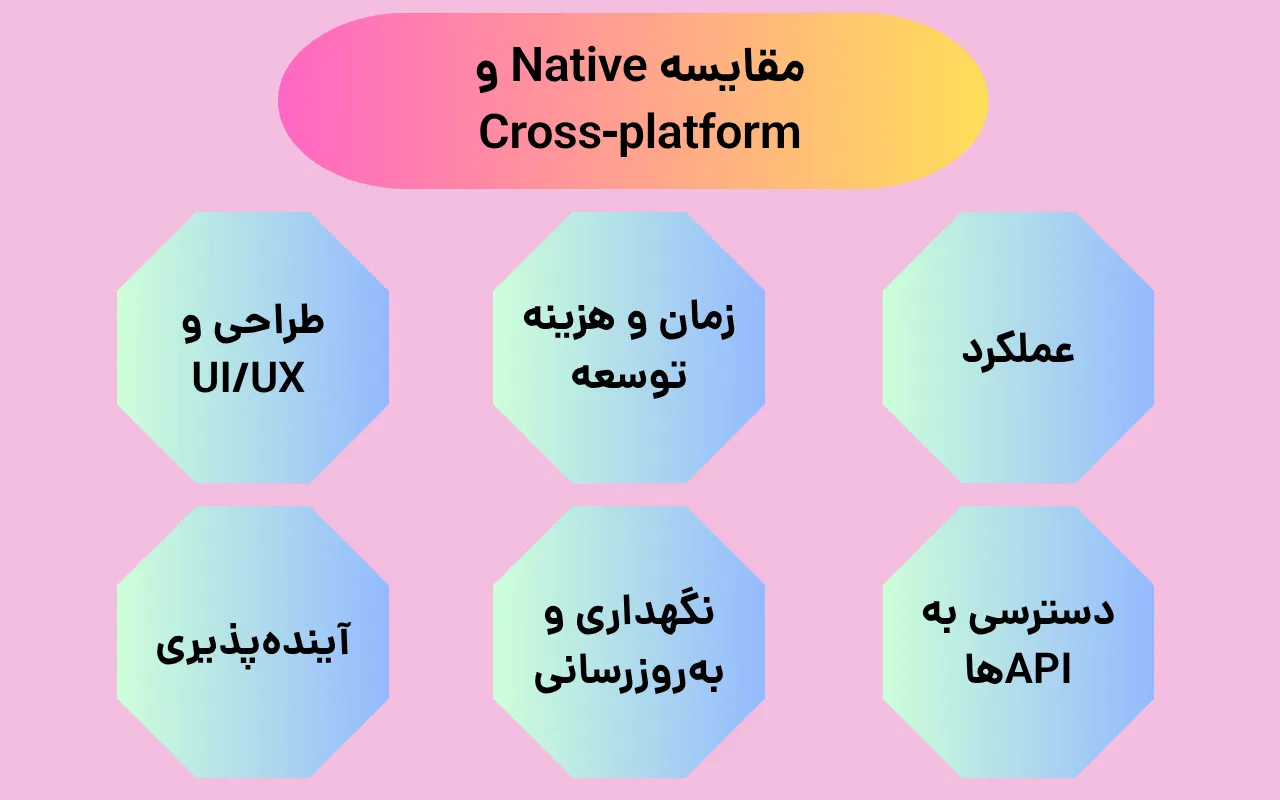
Performance: native usually performs better, because it interacts directly with the hardware. Cross-platform performs acceptably in lightweight apps but may show a drop in quality in complex or graphics-intensive ones.
Development time and cost: writing the code once, cross-platform speeds development up and is economical for a small team. Native development costs more and takes longer, but produces a more precise result.Design and UI/UX: native apps appear in complete accord with the operating system's own design, and the designer has more freedom to customise. Frameworks such as Flutter have tried to close that gap, but native design still allows more flexibility.
Access to APIs: native has direct access. In cross-platform, reaching some capabilities sometimes takes custom modules or bridging libraries.
Maintenance and updates: cross-platform is simpler to maintain because there is one codebase. Platform-specific updates within it, though, can become complicated.
Longevity: the developer community for native is very large and well established. Cross-platform frameworks, however, are establishing their own place as they grow (Flutter with Google's backing, for instance).
Which option suits which kind of project?
To decide properly, you have to weigh the project's needs as well as the trends in the market:
Complex, graphics-intensive apps, or those needing high performance (financial apps, games or advanced medical apps, for instance) are usually better built with a native approach.
But projects that need a quick release, a market test, or economical development (content, educational or simple service apps) can take advantage of cross-platform.
The experience of some start-ups in Iran shows that using Flutter or React Native in the early phase has reduced costs and brought the product to market faster. In some cases, though, teams have gone on to rewrite the app natively after that initial growth in order to get past the limits. All of this shows that choosing a framework takes a long view and an analysis of the project's future, not merely speed at the start.
The part strategy and design play in choosing a platform
Choosing between native and cross-platform is not a purely technical decision; it is bound up with a set of strategic factors, from the business model and the team's budget to the experience you want to give the user. If your app needs intensive graphical interaction or uninterrupted performance, for instance, the greater cost of native development may be justified. But if you are at the MVP phase and want to reach the market quickly, building with Flutter or React Native may be the better option.
What many teams overlook is the part UI/UX design plays in settling the platform. Apps with a demanding design, or with particular interactions in them, may run into difficulties in cross-platform that should be weighed in the decision from the start.
In summary
In closing, it should be stressed that there is no absolute answer to choosing between native and cross-platform. Every project needs a different route depending on its goals, its constraints, its technical team and its target audience. Native offers speed and precision, but it costs more.