In recent years, artificial intelligence (AI) has become one of the most important and widely used technologies in the content industry. With the development of large language models such as GPT-3 and GPT-4, it has gained remarkable capabilities for producing written content.
Since the introduction and release of tools such as ChatGPT by OpenAI and Gemini (first introduced as Bard) by Google DeepMind, we have seen a striking increase in the use of artificial intelligence for content creation. These tools let writers, content marketers and businesses produce the content they need quickly and efficiently.
The rapid growth and adoption of AI technology has also raised concerns, however: about its effect on the quality of content, about the employment of human writers, and even about legal and ethical questions in content creation. It cannot be denied, though, that artificial intelligence has become an important and unavoidable tool in the world of content.
In this article we introduce ten of the best AI content creation sites, so that you can choose the best option for your business's needs. By looking at the advantages and disadvantages of each, we will help you make the best decision about using this technology in your own content work.
Why artificial intelligence matters in content creation
There are a number of reasons and advantages to using artificial intelligence in content creation that have made it one of the essential tools in today's digital world. At a time when the speed of producing and publishing content is vital to success in digital marketing and to reaching an audience, artificial intelligence lets writers and marketers reach their goals more efficiently, more quickly and more cheaply.
One of the main reasons artificial intelligence matters in content creation is greater productivity and time saved. AI content tools can create good content in a short space of time, which helps human writers focus on the more creative and more complicated parts of the work. AI tools can quickly produce a first draft of an article or a blog post, for instance, which a human writer then reviews and improves.
Artificial intelligence can also produce bespoke content optimised for SEO. These tools readily identify the keywords needed and produce content that accords with search engine algorithms. That helps a business improve its search rankings quickly and reach a wider audience.
Another reason artificial intelligence matters in content creation is lower costs and better use of resources. Hiring and training human writers is expensive and takes time, whereas AI tools can produce the content needed at a lower cost and in less time. That matters particularly for small businesses and start-ups with a limited budget.
Finally, artificial intelligence can provide access to data and more precise analysis, which can lead to more effective and better-targeted content. By analysing data and audience behaviour, AI tools can produce content that answers people's needs and interests, and that means the content receives a better response from its audience.
Given these advantages, using artificial intelligence in content creation has become a fundamental approach to success in digital marketing. Below, we look at the best AI tools for creating content.

The important qualities to look for in an AI content creation tool
Choosing an AI content tool that effectively meets your needs can be challenging, particularly given how many are available. To make sure you choose the right one, you should pay attention to a few key qualities that play a very important part in how these tools perform.
Accuracy and quality of the content produced
The most important quality of an AI tool is its ability to produce content of good quality and without errors. It has to be capable of creating content that is not only grammatically and orthographically correct but also accurate in substance and relevant to the subject. Some AI tools use advanced language models such as GPT-4 that can produce complex, precise content.
Compatibility with SEO
One of the main purposes of producing content is to improve your search engine ranking. The tool you choose should therefore be able to optimise content for SEO. That includes using the right keywords, structuring content so that search engines can understand it, and producing compelling titles and descriptions to attract an audience.
Flexibility and the ability to customise
Every business has its own particular needs in content creation. An AI tool should be flexible and allow content to be customised for writing style, length or even target audience. That lets you create content that matches your business's needs precisely.
Support for different languages
If your business serves an international audience, choosing a tool that supports different languages can be very useful. That way you can produce multilingual content and reach new markets.
A simple, easy interface
An AI content tool should have a simple, user-friendly interface. That helps you use the tool easily and create the content you want without needing advanced technical knowledge.
Integration with other tools
A content tool able to integrate with other digital marketing tools and with content management systems (CMS) can make producing and publishing content considerably easier. That integration may include SEO tools, email marketing or social networks.
Cost and value
The cost of using AI tools can vary a great deal. Some have monthly or annual subscription plans, while others charge on the basis of the number of words produced. It is important to compare a tool's costs against your business's budget and needs in order to choose the best option.
The ability to learn and improve continuously
The best AI content tools are able to learn from feedback and improve their own performance continuously. That means that as you use a tool, you get better results and the content it produces improves over time.
Bearing these qualities in mind, you can choose the best AI tool for your content and reach your business's goals. Below, we introduce ten of the best AI tools in this field.
10 of the best AI content creation tools
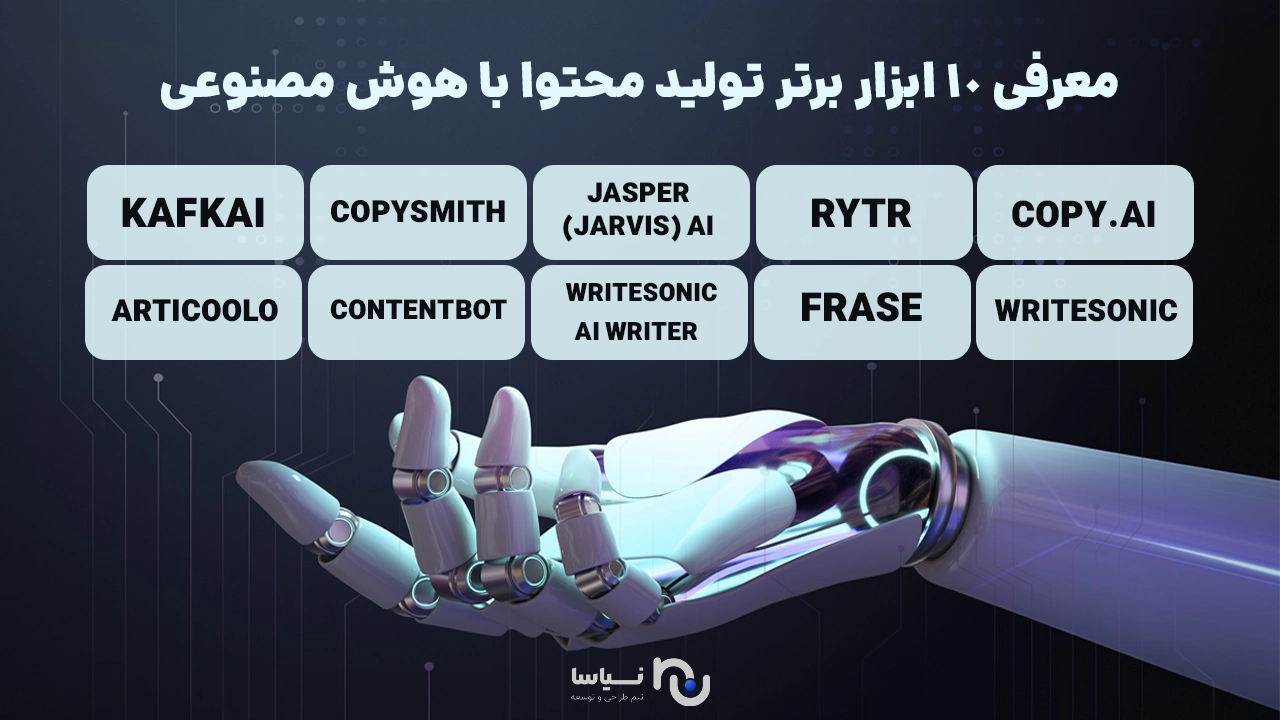
In this section we examine and introduce ten of the best AI tools used for content creation. Each has its own distinctive characteristics and capabilities that can help improve the process of producing content. Given that three of these tools should be accessible in Iran without restriction, we begin with those.
Copy.ai
Copy.ai is one of the popular and widely used AI content tools, and it is readily accessible in Iran. It draws on advanced language models to create written content in a range of forms: articles, blog posts, product descriptions and social media content.
With its simple, user-friendly interface, Copy.ai lets users produce the content they need quickly and easily. It also supports Persian, which is a considerable advantage for Iranian users.
Strengths:
- Produces good, varied content
- A simple, user-friendly interface
- Supports a range of languages, Persian among them
Weaknesses:
- The content can sometimes be random and lack coherence
- Manual editing is needed to reach a high standard
WriteSonic
WriteSonic is another AI content tool accessible in Iran without restriction. It lets you quickly produce a range of content: articles, blog posts, email content and even advertising.
WriteSonic has a number of customisation options that let you create content in your business's own style and tone. It also uses SEO optimisation techniques and helps you produce content matched to the keywords you want.
Strengths:
- Produces content quickly and to an acceptable standard
- Content can be customised and optimised for SEO
- Supports a range of content formats
Weaknesses:
- In some cases the content may need correcting and editing
- The subscription costs may be high for some users
Rytr
Rytr is another AI content tool that Iranian users can readily reach. It lets writers and marketers produce a range of content: articles, product descriptions, social media posts and marketing emails.
With its simple interface and its speed, Rytr helps users get their content in the shortest possible time. It also supports Persian and lets you produce the content you need in your own language.
Strengths:
- Produces content in little time
- Supports a range of languages
- A simple interface, well suited to beginners
Weaknesses:
- It may be weak at producing complex content
- Content quality may be poor on certain subjects
Jasper (Jarvis) AI
Jasper AI (previously known as Jarvis) is one of the most powerful AI content tools. It uses advanced language models such as GPT-3 and lets you produce a range of written content: articles, product descriptions, blog posts and social media content.
With Jasper AI you can create content in a range of languages and take advantage of its SEO optimisation features as well.
Strengths:
- Produces content of high quality and accuracy
- Can produce long, complex content
- SEO optimisation features
Weaknesses:
- A high subscription cost
- Takes more experience to make full use of its capabilities
Writesonic AI Writer
Writesonic is another popular AI tool that helps you produce a range of written content. It can create articles, blog posts, product descriptions and social media content. Writesonic also lets you optimise the content it produces and take advantage of SEO techniques.
Strengths:
- Produces content to a good standard
- Can produce advertising and marketing content
- Content can be customised
Weaknesses:
- The content may need manual editing
- It may be weak at producing analytical content
Copysmith
Copysmith is a tool designed particularly for content marketers and for businesses looking to produce advertising and marketing content. It can help you create engaging, effective advertising copy, marketing emails and product descriptions.
Strengths:
- Able to produce good advertising content
- Can create marketing emails and advertising copy
Weaknesses:
- Limited at producing non-advertising content
- Content quality may be lower than that of other tools
ContentBot
ContentBot is another AI tool that lets you produce a range of written content. It has a variety of capabilities, from creating articles and blog posts to producing product descriptions and social media content.
Strengths:
- Produces varied content in a range of formats
- Can create content for blogs and websites
Weaknesses:
- In some cases the content is of a lower standard than expected
- Manual editing is needed
Kafkai
Kafkai is an AI tool that lets you produce good-quality articles across a range of fields. It is particularly useful for blogs and websites that need varied, up-to-date content.
Strengths:
- Produces good content in particular fields
- Able to create long, analytical articles
Weaknesses:
- Limited across different subjects
- Takes experience to get better results
Articoolo
Articoolo is one of the older, popular AI content tools, letting you create short articles and good written content. Using advanced algorithms, it helps you produce content that is accurate and relevant to your subject.
Strengths:
- Produces short articles quickly and easily
- Simple to use
Weaknesses:
- The quality of the content produced may not be adequate
- Limited at producing long content
Frase
Frase is an AI content tool that, as well as producing text, helps you research and analyse keywords and related subjects. It lets you produce content optimised for SEO and improve your search engine ranking.
Each of these tools has its own distinctive capabilities and characteristics that can help you in the process of producing content. In the sections that follow, we look at each of them in more detail so that you can choose the best option for your needs.
Strengths:
- Keyword research and analysis
- Able to produce content optimised for SEO
Weaknesses:
- It may be weak at producing creative content
- Takes experience to use effectively
A guide to choosing the best AI tool for content creation
Choosing the best AI content tool depends on a number of factors, which we examine in this section. Depending on your needs and goals, you can choose the right tool. Here are a few key points to help you in that process:
• Identify your needs and goals: before choosing a tool, you have to identify your needs and goals clearly. Are you looking to produce advertising content, or content for a blog and scholarly articles? Clear goals help you choose a better-suited tool.
• Examine the capabilities and features: look at each tool's capabilities and see which best matches your needs. Look for features such as producing content in a range of formats, SEO optimisation and the ability to customise content.
• Evaluate content quality: evaluate the quality of the content each tool produces. It is best to look at samples before making a final choice, so that you can be sure of their quality.
• Costs and subscription models: compare the tools' costs and subscription models. Some may be expensive, so you have to consider whether they are worth the investment. Some also offer free options or trial versions that you can try.
• Support for different languages: if you need to produce content in different languages, Persian among them, make sure the tool you choose supports them. This matters a great deal for Iranian users.
• User reviews and feedback: read the reviews and feedback of previous users. They can help you get a better picture of how the tools perform and let you draw on other people's experience.
• Test and evaluate: before making a final decision, it is best to try several tools and evaluate how they perform in practice. That way you can be sure which one best meets your needs.
Bearing these points in mind, you can choose the best AI tool for your content and take advantage of what it offers. In the sections that follow, we look at use cases and at key points in producing good content.
Key points for producing good content using AI tools
Producing good content with AI tools takes attention to detail and to a few key points. In this section we look at the important points that will help you make the best use of these tools and produce content of an acceptable standard.
• Use precise, clear inputs: to get the best results, the inputs you give an AI tool have to be precise and clear. A precise description of the subject, the writing style and any particular requirements can help produce better content.
• Edit and improve the content: content produced by AI tools usually needs editing and improving. After producing content, always review it and make the corrections needed to bring it up to standard.
• Keep your brand voice: the content produced should accord with your brand voice. Make sure the writing style and the tone of the content match your brand's identity. That helps you build a better relationship with your audience.
• Use credible information: in producing scholarly and analytical content, use reputable sources and accurate information. AI tools usually cannot provide accurate information, so it is best to check and verify it yourself.
• Optimise for SEO: content should be produced with search engine optimisation in mind. Use the right keywords and structure the content so that search engines can identify it readily.
• Engage with your audience: try to design the content you produce so that it engages your audience more. Using questions and calls to action in your content can help attract and hold their attention.
• Follow up and update your content: producing content is a continuous process. After publishing, follow the feedback and the performance and make any updates needed so that your content always stays current and relevant.
Observing these points, you can produce better content and make the best use of AI tools. Below, we look at the future effects of artificial intelligence on content creation.
The future effects of artificial intelligence on content creation
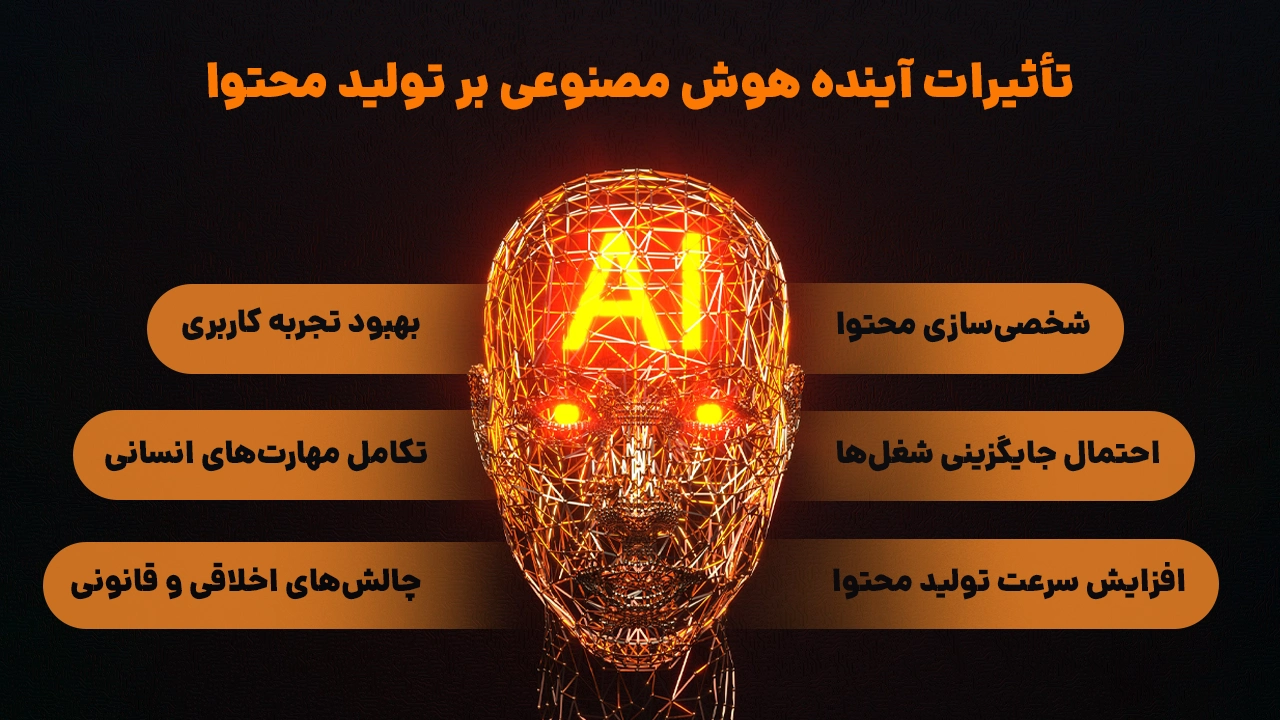
Artificial intelligence is changing quickly and has a considerable effect on the content industry. In this section we look at those effects and at the future artificial intelligence may bring about for content creation.
Faster content production
One of the greatest effects of artificial intelligence on content creation is the speed at which content can be produced. AI tools can produce the content needed in a fraction of the time, which can help a business answer the market's needs quickly.
Personalised content
Artificial intelligence makes it possible to personalise content around users' needs and interests. That can increase audience engagement and satisfaction and, with them, have a positive effect on sales and customer loyalty.
A better user experience
AI tools can help improve the user experience. By analysing user data and behaviour, it is possible to produce content that answers people's needs specifically and holds more of their attention.
Ethical and legal challenges
As the use of artificial intelligence spreads, ethical and legal challenges increase as well. Questions such as copyright, ownership of content and the social effects of producing content with artificial intelligence have to be examined carefully.
The possibility of jobs being replaced
One of the main concerns about artificial intelligence is the possibility of jobs in the content industry being replaced. Although artificial intelligence can act as a tool that helps, some jobs may decline because of automation.
The evolution of human skills
As artificial intelligence advances, the need for new skills grows as well. Content producers have to keep their abilities up to date and become familiar with new tools in order to stay competitive.
The part human writers play
Human writers will continue to play a vital part in content creation. Good, original content takes critical thinking, creativity and the ability to analyse deeply, and artificial intelligence cannot fully replace them.
New opportunities for creativity
Artificial intelligence can help content producers arrive at new ideas by drawing on data and intelligent analysis, and so extend their own creativity.
Bearing these effects in mind, the future of content creation with artificial intelligence can move towards better quality and greater speed, but the challenges have to be examined and managed as well. Below, we summarise the article and its overall conclusions.
Artificial intelligence and the future of content creation
In this article we have looked at the effects and advantages of artificial intelligence in content creation and introduced ten of the best AI tools that can be used in this field. Given how quickly this technology is changing, we have also examined the key points and the challenges ahead. In this section, we summarise the material and its overall conclusions.
• A revolution in content creation: artificial intelligence is bringing about a revolution in the content industry. With its remarkable ability to analyse data and produce good content, this technology can help a business answer its customers' needs quickly and improve the content it produces.
• Combining human creativity and artificial intelligence: although AI tools are able to produce content, human creativity and critical thinking are still needed. Combining human abilities with artificial intelligence can lead to distinctive, high-quality content.
• Challenges and opportunities: the advance of artificial intelligence brings new challenges with it. Questions such as copyright, information security and social effects have to be examined. At the same time, new opportunities for creativity and innovation open up that can help the content industry grow.
• The need for training and skills development: content producers have to keep their skills up to date and become familiar with AI tools. Training and skills development help them take advantage of this technology and stay competitive in the digital world.
• A bright future: given how quickly AI technology is developing, the future of content creation looks very bright. AI tools let a business produce content quickly and to a high standard and carry on growing.
Broadly, artificial intelligence not only helps improve the process of producing content, it can also act as a strong companion to writers and content producers. With that approach, we can look towards a promising future for the content industry.
Conclusion
Artificial intelligence lets content producers work faster and more precisely. With AI tools, good content that meets an audience's needs can readily be produced.
Considerable as its capabilities are, artificial intelligence cannot replace human creativity and thought. Combining human abilities with AI technology helps produce distinctive, valuable content. The ethical and legal challenges bound up with artificial intelligence also remain. Questions such as copyright, ownership of content and social effects have to be examined and managed carefully.
Artificial intelligence opens new opportunities for innovation and creativity in content creation. Using this technology can help improve content strategy and reach an audience better. In the end, as a strong collaborator in the process of producing content, artificial intelligence can help us reach better results and succeed in a competitive digital world.